Analysis · document and video ·
Secret chivalric orders: grand titles — but what is actually taught?
What does a member gain beyond a title? Programmes, the Academy’s public offers, the history of the Dragon Order and leadership accountability, alongside a document and video.
“Secret Masters and Dragan the Dragon” — contributor’s caption
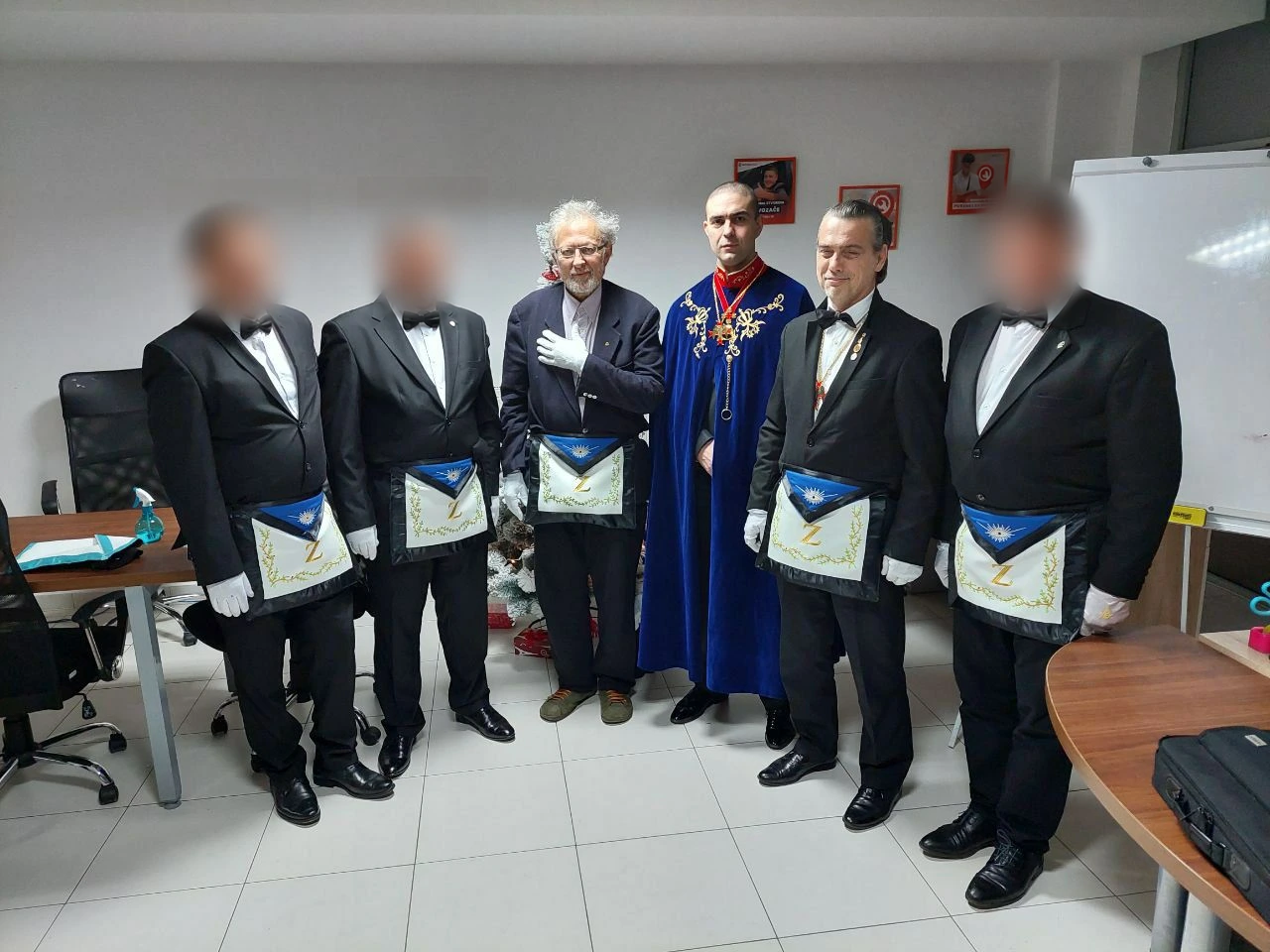
Ceremony video: Nemanjić Order according to the contributor
Source: Rumble, PrviGarant channel, title “Dragan Pop”. The contributor describes an initiation into the Nemanjić Order and identifies a participant as Dragan Palačković. Identity, role and any clerical status have not been independently verified. This short excerpt does not provide the full ceremony context.
If the video does not start after pressing Play, reload the player. This resets playback to the beginning.
Do you support the views expressed in this video?
You are rating the views expressed, not the usefulness of the post or analysis. Votes do not verify facts. Click again to remove your vote.
Loading…
Comments
Criticism of our work is welcome. Insults, threats, personal data and calls for harassment are not allowed. An editor reviews every comment before publication.
What remains after the ceremony?
Swords, cloaks, medals and oaths can make a powerful impression. The intensity of an experience and the value of teaching are different things. A ceremony shows admission, but does not by itself show what a member will learn. What does the order actually do once the ritual ends?
Do members study sources, practise ethics, undertake charitable work or mainly acquire new ranks? Each order needs its own assessment. An unpublished ritual does not prove a lack of substance, but secrecy cannot answer every question about teaching, money and governance.
The Academy’s promises and advertised lectures
On its objectives page the Academy claims the greatest esoteric knowledge, listing Masonic systems, chivalric and Templar orders, the Dragon, Black Eagle, Illuminati and Martinists. This is the organisation’s self-description, not an independent quality assessment. Who checks teaching accuracy and what makes the knowledge the greatest?
There is a public offer. The Esoteric Academy platform describes the Grgurević Order lecture as a dramatised historical ritual presentation and the Slavic Chivalric Order through virtues and ancestral commitments. On 22 October 2026 both were advertised at RSD 24,000. An advertisement establishes an offer, not the quality of the entire programme. A lecture price does not establish initiation or membership fees.
Curriculum, advancement and the right to question
Describing an atmosphere is not a curriculum. Applicants should know duration, reading, authors, assignments, methods and advancement criteria. How do Dragon, Black Eagle and Nemanjić teachings differ? Multiple names make educational sense when their content differs clearly. Historical inheritance should be distinguished from modern interpretation.
The French Ordre du Dragon describes grades introduced from 1934, each with its own ritual and variations on the dragon symbol. This describes ritual structure; the homepage reviewed does not provide a detailed curriculum. Mutual recognition establishes a relationship, while educational value requires further evidence.
A name does not establish provenance
Dragan Tojagić’s public presentation lists the Dragon, Black Eagle, Nemanjić, Svevladović and Grgurević orders, among others. This establishes that the names are used, not the organizations’ age, continuity or authority.
A modern association may celebrate history and conduct rituals. Claims of medieval institutional succession require evidence of transmission. A coat of arms, cloak or ornate certificate does not supply it.
1408 is not 1389
The Hungarian National Museum dates the Order of the Dragon’s foundation by Sigismund of Luxembourg and Barbara to 1408. Stefan Lazarević was an early member. The Battle of Kosovo occurred in 1389, nineteen years earlier.
The institution founded in 1408 therefore could not have participated in the 1389 battle as that institution. Dragon imagery, epic tradition and the despot’s later membership do not establish continuity to modern associations.
What the Academy publishes
The Academy’s essay “Viteštvo” places the foundation in the fourteenth century, credits Stefan Lazarević and names Kruševac as its seat. It also links the order to the Nemanjić dynasty. This conflicts with the documented 1408 foundation.
The essay is signed “Brat N.S.” We examine Academy-published content, not a personal quotation attributed to Tojagić. An educational organization should identify sources and correct verifiable historical errors.
Kosovo: emotion is not authorization
Associating a private order with Lazar, Kosovo or the Nemanjić dynasty can transfer respect for historical heritage to present-day leaders. This is editorial analysis of presentation, not proof of hidden intent.
Respect for Serbian history does not require accepting a private association’s titles. Questioning its claims is not an attack on faith or ancestors. Respect for tradition requires distinguishing history, legend and contemporary ritual.
French filiation and missing centuries
The French website lists Serge Guillemot as Grand Master, Michel Picandet as deputy and George Petrescu as Grand Inspector. These are the organization’s own descriptions.
Its one-page filiation lists medieval figures followed by modern leaders with dates beginning in 1934, but provides no archival instruments bridging those eras. A membership list is not a documented succession chain. Mutual recognition may establish present cooperation; it does not bridge centuries.
What the certificate shows
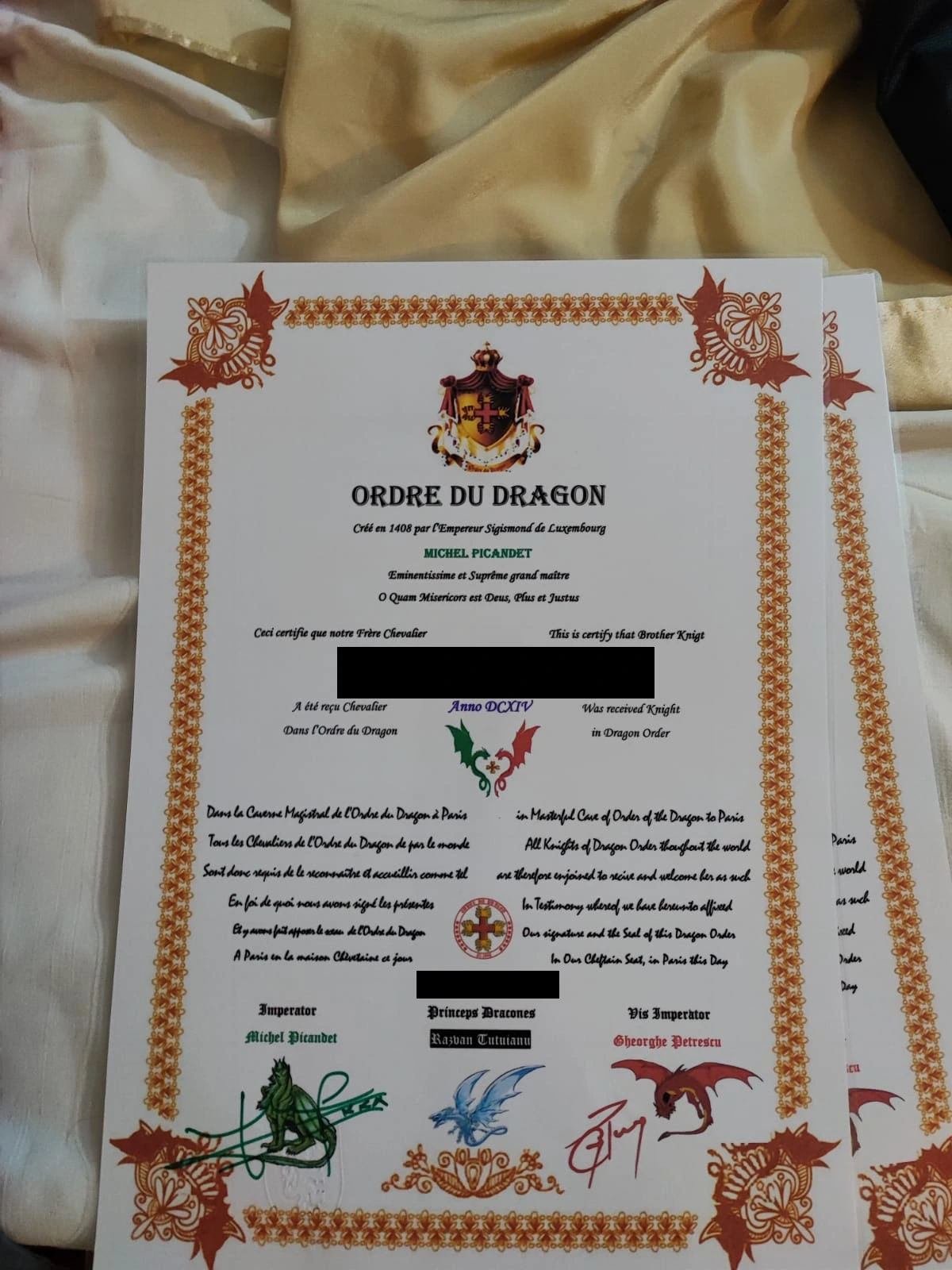
The supplied photograph bears Ordre du Dragon, a 1408 foundation claim, and the names Michel Picandet and Gheorghe Petrescu among its titles and signatory fields. It presents its recipient as an admitted knight.
It does not itself establish signature authenticity, historical continuity, payment or Tojagić’s authority; his name is absent from the displayed page. This certificate concerns the Dragon Order, while the video is described as a Nemanjić Order ceremony.
Payments: an allegation requiring corroboration
Citing close acquaintances who were present, the contributor says Tojagić learned from Picandet and Petrescu, paid to use their system, and later operated independently. This is second-hand testimony, not an independently verified financial finding.
“Franchise” is the contributor’s description, not an established contractual classification. Contracts, correspondence, receipts or direct testimony are needed. Claims about Tojagić’s private assessment of the system remain interpretations of motive.
Ceremony, faith and accountability
The video appears with source attribution and the contributor’s description. Clothing and ceremonial actions do not establish ecclesiastical authorization. This material does not establish that a participant is a priest, impersonates one, or has church approval.
The Academy describes personal development, responsibility and humanitarian work among its partners’ objectives. Ask for verifiable results and accounts rather than assume every order lacks purpose. Where fees exist, candidates should know the recipient, benefits and financial oversight.
A grand name attracts attention. Accurate information and accountability earn trust.
What do members gain, and who holds leaders accountable?
Charging for teaching or membership does not itself establish abuse. Applicants should know their total obligations, the recipient of payments, what they receive and how they can leave. Advancement needs clear criteria of work and knowledge, with financial obligations explained separately from personal worth or loyalty.
Claims of chivalric ethics and charity should be supported by safeguards for members’ dignity and verifiable outcomes. Who appoints and removes leaders? Is there an appeal? Can members challenge a teacher or leave without humiliation? Public pages do not reveal all internal work, but their promises can be examined. After a year, what does a member understand, do and apply better, without listing titles?
Questions a title cannot answer
- When was the modern organization founded, and who governs it?
- Which documents connect it to the historical order?
- Who grants authority, and who recognizes it outside the affiliated circle?
- What are its programs, results and membership conditions?
- Where do payments go, and how is spending reported?
- In what capacity do ceremonial participants act, and is church approval claimed?
Was this analysis useful?
Reader reactions do not verify the analysis. Click again to remove your vote.
Loading…
Comments
Criticism of our work is welcome. Insults, threats, personal data and calls for harassment are not allowed. An editor reviews every comment before publication.