FEATURED ANALYSIS ·
Alliances of alliances: how many independent organizations stand behind the grand names?
Links between Tojagić’s public presentation, Tracia and French Burgundy: what the sources establish and what remains unresolved.
1. More names do not necessarily mean more independence
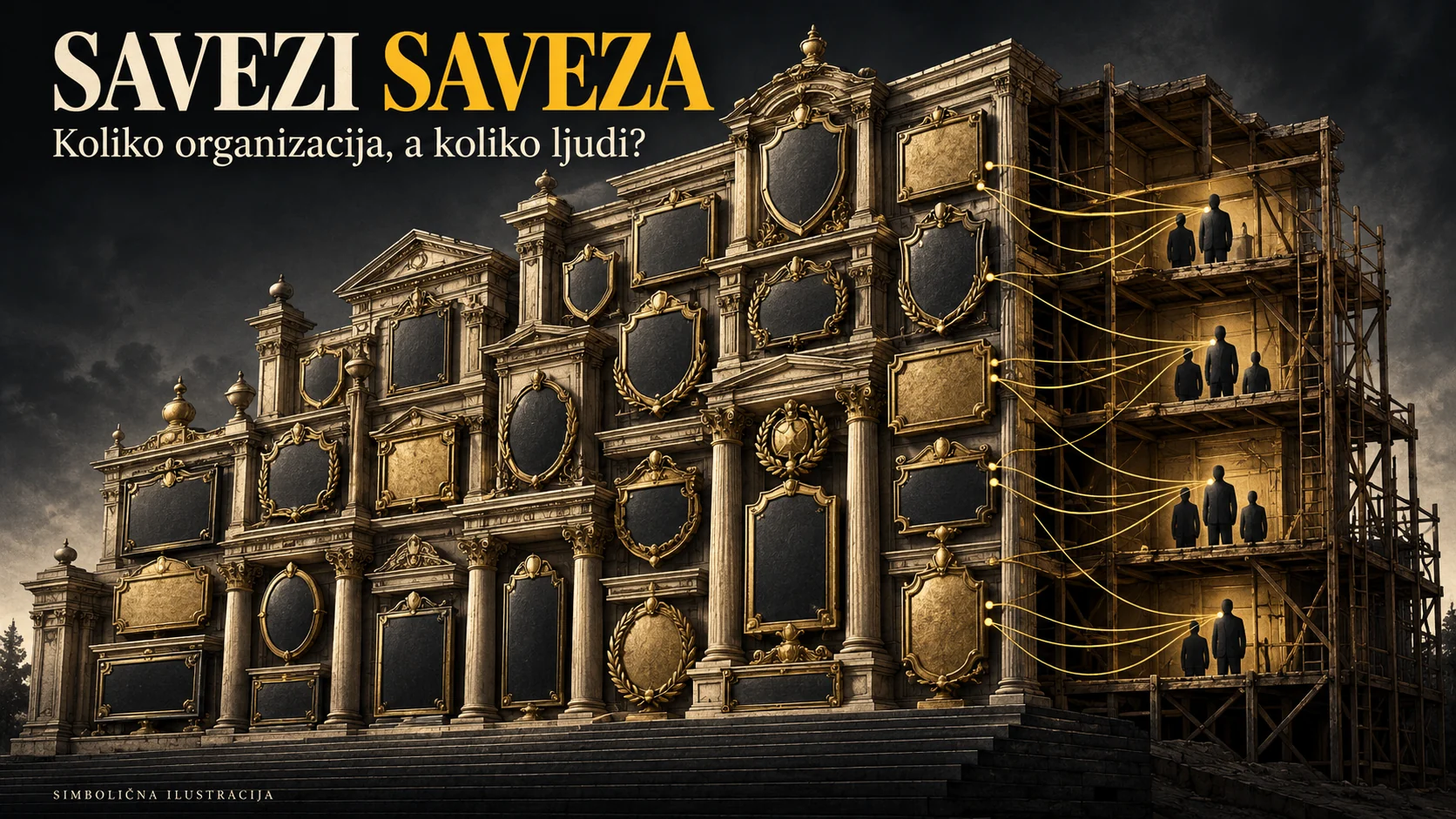
A list of grand lodges, supreme councils, academies, knightly orders and international alliances can suggest extensive institutional backing. The number of names does not establish how many distinct people, independent governing bodies or active organizations stand behind them.
The Academy lists more than 30 grand lodges described as its own, seven supreme councils and a project to unite 20 European Masonic alliances. Tojagić’s biography mentions an alliance of ten alliances and 25 academies of the secret world. These are self-published claims. Lodges, alliances, academies, ritual degrees and registered associations are different categories and cannot simply be added together.
One lodge may belong to several alliances and one person may hold several offices. Different rites or jurisdictions can justify separate structures. The question is whether the number of names is used as evidence of authority without explaining their independence.
2. Tracia: a documented connection, not proof of copying
According to its website, Grande Alliance Maçonnique Tracia was founded in Brașov on 4 April 2017. Its listed founders include Michel Picandet, George Petrescu, Catalina A. Georgescu, Enzo Polimeni and Alexander Rybalka. Its membership page includes the Nikola Tesla Grand Lodge in Serbia.
Romanian Dacia presents Picandet as world grand master of SSD. These sources document publicly stated connections and offices. They do not prove that Tojagić controls the network or copied its system. Copying would require dated statutes, organizational charts and comparison of specific texts. Mutual recognition is not universal recognition.
3. Burgundy: two associations and a shared-address lead
Burgundy does not denote a single legal entity. A French official notice records Grande Loge Symbolique Burgonde — GLSB (W912002871), declared on 22 January 2010 in Viry-Châtillon. Another records Souverain Sanctuaire des Marches de Burgondi (W213001680), declared on 12 December 2014 at 8, rue Saint-Baudry, Étalante.
The Cerfapp directory now also lists GLSB at that Étalante address. This suggests a shared registered address, despite different original headquarters. The primary notice recording GLSB’s move was not obtained. Sharing an address does not establish that an association is fictitious: governance, membership and financing must be examined separately.
4. Picandet’s multiple organizational roles
The OESB knightly order’s website describes Picandet’s role in its development. Tojagić’s biography on Zakazime lists OESB membership. This is a publicly claimed link through the same order, not independent confirmation of every title.
Grande Hiérophanie Mondiale marks its 2011 agreement with the Burgundy sanctuary as inactive. A discontinued relationship with that organization is not evidence of expulsion from Grand Orient de France (GODF). No reliable confirmation of the alleged expulsion or a GODF schism creating Burgundy was found; neither is presented as fact.
5. A legal entity is not the entire network
CompanyWall lists International Esoteric Academy doo Novi Sad as founded on 14 August 2024, registration number 22037331, with Dragan Tojagić as director and sole owner. This is a business aggregator’s record, not an APR extract obtained directly.
Ownership of that company does not establish control over every lodge, alliance or order listed on its website. A recent incorporation date alone also does not settle whether an earlier tradition or activity existed.
6. What would make meaningful scrutiny possible
The central question is how many organizations make independent decisions and can hold their leaders accountable. Scrutiny does not require publishing private membership lists: verifiable aggregate figures and clear accountability rules can suffice.
The sources support discussion of a multilayered network and some recurring leaders. They do not establish that every organization is a front or that the same ten people constitute them all. Trust depends on knowing who decides, on whose behalf and under what oversight.
- Legal status and registration number, where applicable.
- Current leadership, term lengths and appointment or removal procedures.
- Active membership figures with overlap explained.
- Powers of each alliance and obligations arising from agreements.
- Members’ financial obligations and expenditure oversight.
Was this analysis useful?
Reader reactions do not verify the analysis. Click again to remove your vote.
Loading…
Comments
Criticism of our work is welcome. Insults, threats, personal data and calls for harassment are not allowed. An editor reviews every comment before publication.